

Sanctions for lack of One Click Return – a real risk for e-commerce
If you are running e-commerce in the EU – whatever its scale – One Click is a topic that requires concrete preparation now, and in the following article we will describe exactly how to prepare for the changes.

Publication date:
Update date:
11.05.2026
Sanctions for lack of One Click Return - introduction
From 19 June 2026, online shops in the European Union will be required to implement a simple online withdrawal mechanism, referred to as One Click Return. The provision applies to all subscriptions and returns of goods in an online shop.
Introduced in accordance with EU Directive 2023/2673, the legislation defines how such a mechanism is to work and describes what consequences e-commerce companies that do not implement the system may face.
Under the new rules, a trader can be found to be in breach of consumer rights, and this means risking control and financial sanctions of up to 10% of the company’s annual turnover.
If you are running e-commerce in the EU – regardless of its scale – this is a topic that requires concrete preparation now, and in the following article, we will describe exactly how to prepare for the changes.
Why will the lack of a One Click Return be treated as a breach of consumer rights?
EU Directive 2023/2673 was designed as a response to the phenomenon of ‘ dark patterns‘, i.e. practices that manipulate users’ decisions. This broad term is used to describe practices that make it more difficult, for example, to cancel a purchase or subscription than the purchase itself.
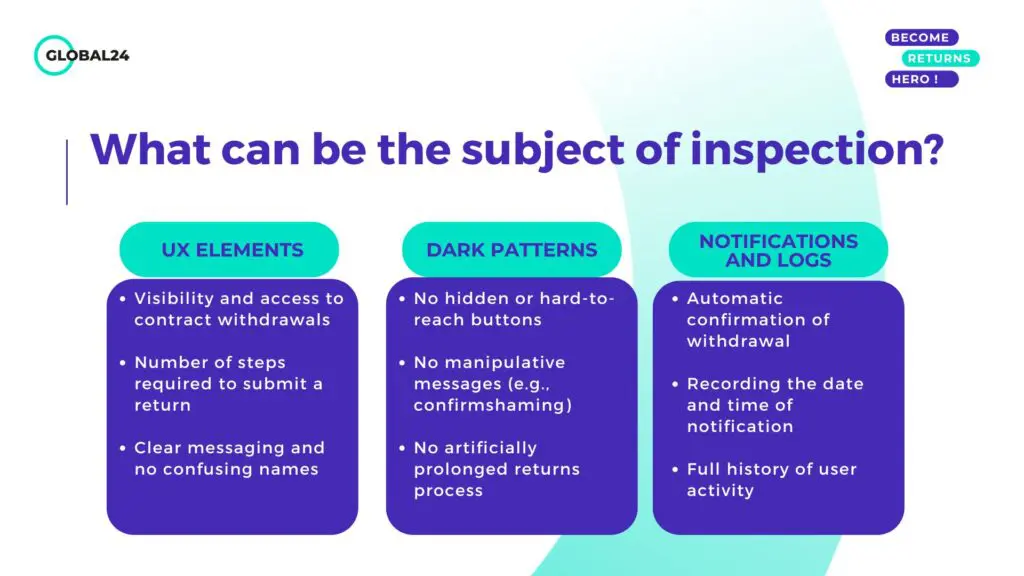
Some of the most common dark patterns in e-commerce include:
-
- hiding the cancellation option or making it less visible than the purchase option,
- lengthening the return process by adding unnecessary steps or redirects,
- using ambiguous messages that make it difficult to understand the implications of a decision,
- forcing contact with customer service instead of allowing the customer to return the item themselves online,
- using so-called confirmshaming, i.e. messages that create guilt or pressure (e.g. “I’m giving up an exceptional offer”),
- making it difficult to find information about the right of withdrawal.
The new rules aim to eliminate such practices. The starting point is simple: if a purchase can be completed quickly and intuitively, the withdrawal process should be exactly the same.
The absence of a One Click Return mechanism can be understood as potential evidence of a violation of consumer rights and lead to an audit or penalty.
What sanctions are there for not having One Click Return in the EU after 2026?
The most obvious consequence is financial penalties imposed by supervisory authorities.
Depending on the scale of the breach, they may not only oblige the company to adapt its processes quickly, but also impose severe sanctions.
In extreme cases, we are talking about penalties of up to 10% of annual turnover. This is a level that, for larger e-commerce businesses, amounts to millions of dollars, and for smaller companies can pose a real threat to financial liquidity.
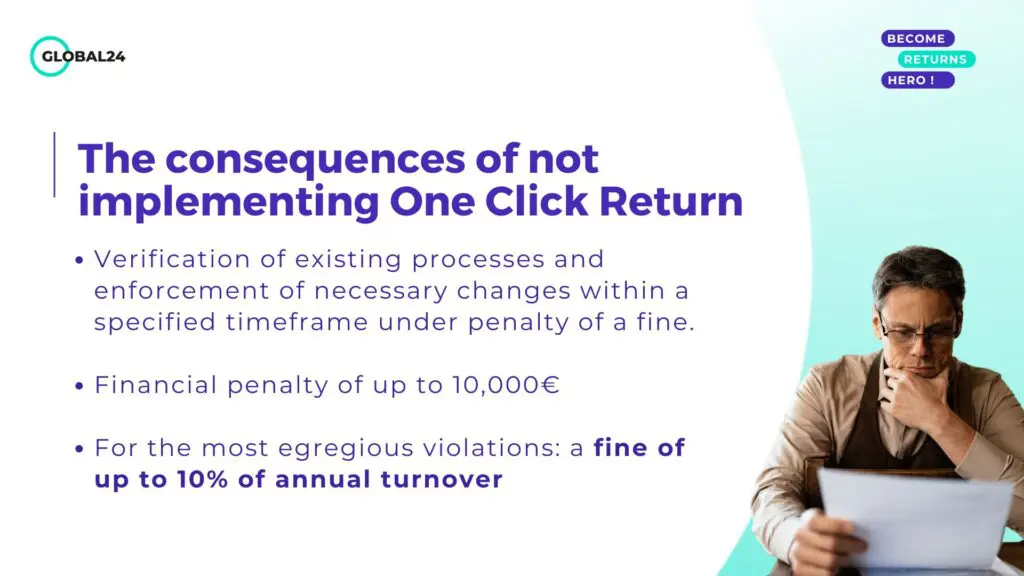
It is worth noting that EU rules only set minimum possible penalties and individual countries may apply stricter rules.
What are the non-financial consequences for not implementing One Click Return in an online shop?
Additional risks are customer claims and potential civil lawsuits. If the user is not able to easily withdraw from the contract, they can assert their rights individually.
This may mean not only having to return the funds, but also the risk of additional costs related to legal services or damages. These are the main non-financial risks:
- Customer claims – the lack of a simple cancellation mechanism can result in individual lawsuits or complaints, which involve not only the return of funds but also additional legal costs or damages. With a larger scale of operations, the problem can become systemic.
- Risk of inspections and audits – once the regulations are in place, companies must prove that the process is operating in accordance with the requirements of the EU directive. This includes the need for logs, claims history and full documentation of returns processes.
Where is the risk of breaching EU Directive 2023/2673 greatest?
Most problems will arise for companies that operate in multiple markets simultaneously. Cross-border sales often mean different language versions of the shop, different systems and different approaches to customer service. It is easy for inconsistencies to occur in such a situation.
It is the lack of a uniform standard that is one of the biggest risks. Even if a process works correctly in a domestic market, non-compliance in another country can be grounds for a breach.
Similar risks apply to shops that still base the returns process on manual handling or require contact with a consultant. Such arrangements may be interpreted as violating the right of withdrawal online.
How to prepare your shop for One Click Return: a checklist for e-commerce companies operating in the EU
If you run an online shop in the EU, you can treat the implementation of One Click Return as a structured process.
Below you will find a practical checklist that you can follow step by step in your shop:
- Check the visibility of the return option
Make sure the customer can easily find the return option in the customer panel or order history. The button should be visible on both desktop and mobile devices. - Compare the number of steps needed to submit a return
The process should be exactly the same in both cases, without the need to contact customer service. - Verify the messages in the shop interface
Button names and messages should clearly indicate that the user is making a withdrawal statement. Avoid ambiguous terms such as “cancel” or “abandon” without context. - Integrate the return process with sales systems
The withdrawal notification should be automatically saved in the sales system (CRM, ERP or OMS) to avoid manual handling and operational errors. - Provide automatic confirmation of the return
Once the declaration has been submitted, the customer should receive a confirmation on a durable medium, e.g. an e-mail with the date and time of the declaration. - Check the consistency of the process across different countries
If you are selling cross-border, make sure that the return mechanism works the same in each language version and in each market. - Test the process from the user’s perspective
It is best to conduct tests with real users or company employees to see if the process is intuitive. - Prepare documentation in case of an audit
Gather a description of the process, interface screenshots, system logs and procedures for handling returns – you may need them in case of supervisory review.
Sanctions are not everything - the real operating cost
It is worth emphasising that the risks associated with One Click Return do not end with penalties. In many cases, the bigger problem turns out to be the operational costs resulting from an inefficient process.
Manual handling of returns, lack of systems integration or information chaos leads to an increase in errors. In the long term, this translates into higher costs than simply implementing a compliant solution.
Therefore, companies that approach change strategically can not only avoid sanctions but also realistically improve their operations. Moreover, the implementation can be finished in 14 days or even less, which we explain in the article “One Click Implementation in 14 days.“
Summary
Failure to implement One Click Return after June 2026 is a real threat to the operational sustainability of e-commerce.
Financial penalties, customer claims, audits and logistical problems are just some of the consequences that can arise if you are not prepared.
Therefore, the safest approach is to start now and treat the changes as a push to optimise the entire returns process.
How can a professional foreign returns service help?
For e-commerce businesses operating in multiple markets, implementing One Click Return very often means rebuilding the logistics of returns. It is this element that can sometimes be the most challenging.
The solution can be an external service that provides local returns addresses, automatic registration of requests and integration with the shop’s systems.
This makes it possible to meet the requirements of the directive and simplify operations at the same time.
Q&A
Can any online shop be penalised?
Yes. The legislation covers all businesses operating in the EU market, regardless of size and sales model.
Can the lack of One Click affect return periods?
Yes. In the case of e-commerce non-compliance with EU regulations, the customer may gain additional time to withdraw from the contract.
Does selling abroad increase the risk?
Definitely yes. Maintaining process consistency across multiple countries is one of the biggest challenges.
Where is the best place to start preparing?
With a UX audit and an analysis of the returns process from the user’s perspective – this usually reveals the biggest gaps.



Do you want to be up to date?
Subscribe to the newsletter
Subscribe to the CROSS-BORDER LETTER newsletter! Learn about news, tricks and secrets in foreign logistics. Check how to sell abroad and achieve more benefits.