

One Click Return in 14 days – how to implement step-by-step in e-commerce (2026)
With this guide, you will create a 14-day plan to implement One Click Return-compliant procedures and prepare your e-commerce for the requirements of the directive.

Publication date:
Update date:
11.05.2026
How to implement One Click in 14 days - the operational process
From 19 June 2026, all online shops in the EU will be required to implement a simple online withdrawal mechanism – the so-called One Click Return.
The change is a result of EU Directive 2023/2673 and should receive particular attention from companies operating e-commerce across multiple EU countries and cross-border sales, as simple product returns will be required on every platform and shop variant.
With this guide, you will create a 14-day plan to implement One Click Return compliant procedures and prepare your e-commerce for the requirements of the directive.
Before you move on to creating a plan to implement One Click Return in your e-commerce
We would like to point out at the outset that the following plan is of course general and indicative. Its purpose is to show you the steps to prepare your online shop for One Click Return implementation within 2-3 weeks.
The exact timeline and scope of the steps will depend on several factors, including:
- your current sales system and its integration with ERP/CRM,
- the quality of the UX in the customer panel and the number of interface changes required,
- the current customer service processes,
- the number of shops and language versions supported by your e-commerce,
- the logistics and returns processes in the warehouse,
- the level of automation of notifications and event registration in your IT systems.
You can think of the 14-day plan as a skeleton of activities to be adapted to the specifics of your business. Some steps may require a shorter or longer implementation time depending on the complexity of the system and the number of integrations.
Day 1-2: Audit of the current returns process
The first stage of the process is intended to allow you to understand how the return process currently works in your shop and where the potential obstacles are, which the authorities may consider to be non-compliant with the EU directive.
Here are the key steps:
- Check the visibility of the option to return the product(s) – the button should be easily accessible in the customer panel or order history.
- Review the number of steps and redirects – the process must not require contact with support and should be as easy as placing an order.
- Identify dark patterns – check that your shop does not use practices that make returns difficult, e.g:
- Hiding the return button in hard-to-reach places
- Adding unnecessary steps or redirects
- Forcing contact with service instead of returning online
- Unclear naming of buttons
- Confirmshaming or ambiguous messages
Here are some examples of prohibited and appropriate practices necessary after the introduction of the 19 June 2026 directive.
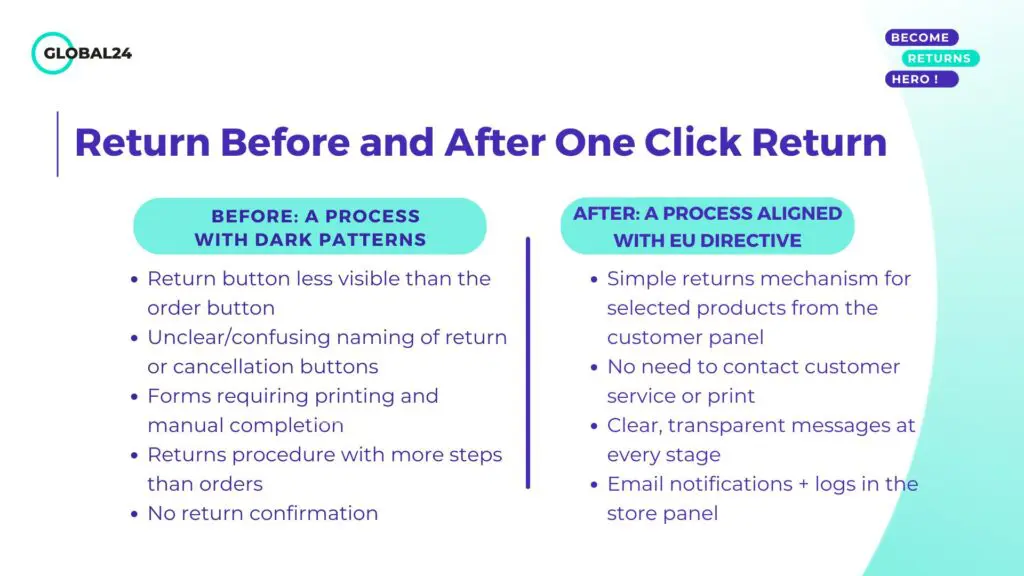
Day 3-5: Designing the One Click Return process in an online shop
At this stage, you create a targeted product return process for the online shop that complies with the requirements of the directive. This is a key moment where you decide on the user experience and eliminate unnecessary steps and ambiguities.
- Simplify the interface (UX/UI) – the ‘Cancel’ button must be visible and unambiguous.
- Map the customer’s steps – from product selection to confirmation of return.
- Take all markets and languages into account – the process must work identically in every language version.
- Ensure proper reporting and notification procedures – make sure your system saves all key logs and correctly delivers notifications regarding the status of the return to the customer.
Day 6-8: Integration of IT systems
Even if you are using a popular e-commerce platform, don’t assume that this stage will be a cake walk. Many systems offer partial handling of returns, but rarely do they meet 100% One Click Return requirements without additional configuration.
This is particularly important if you sell in multiple countries and in a cross-border model. You need to ensure that in such a situation, your customers have an equally straightforward process in each variant, that they receive a full package of information, and that the returns of products and funds themselves run smoothly. If this is already one of your significant challenges at this stage, it may be a good time to consider professional support for overseas e-commerce returns.
So, in summary, your aim at this stage is to verify that your current tools actually provide full compliance with the requirements of the directive, rather than just ‘handling returns’.
When might you have less work to do?
If you are using popular platforms and off-the-shelf solutions:
- the return process is already available in the customer panel,
- the system automatically saves your requests,
- e-mail confirmations are generated,
then implementation can be limited to configuration and testing.
When will changes be necessary?
Most often, significant updates are needed when:
- the return requires customer service contact,
- the process is not integrated into the CRM/ERP,
- there is no automatic confirmation of the request,
- the system does not record the full history of user actions.
Day 9-11: Testing and quality control of the One Click Return process
Check that the process works as designed – both from the user’s perspective and from the systems’ perspective. This is the moment to catch errors before the client or control body does.
- UX testing – check the process from a real user’s perspective.
- Cross-border/multichannel testing – the process should work identically in every language version, market and platform.
- Simulation of mass returns – make sure the system generates confirmations with multiple products at the same time.

Day 12-13: Operational procedures and training of the e-commerce team
The One Click Return process cannot rely solely on technological changes. Your team must understand the new procedures and be able to react in non-standard situations.
- Instructions for the team – show them how to respond when there are problems with the return process.
- Handle exceptional cases – e.g. a lack of integration with the warehouse or a problem with payments.
- Standardise procedures – all employees use the same guidelines.
Day 14: Documentation and readiness for inspection
Finally, you secure formal assurance. This stage is crucial from a compliance point of view – it allows you to demonstrate that your process is working properly and meets the requirements of the directive, protecting you from severe sanctions.
- Logs and submission history – needed when checking compliance with the EU Directive.
- Screens and process description – show how One Click Return works step by step.
- Final verification – make sure the process works correctly across all channels and markets.
The biggest risks in implementing One Click Return
If the return process itself has been well designed, most common errors can be avoided relatively easily. An overly complicated form, a lack of confirmation of the request or vague messages are problems that usually result from oversights at the design stage and can be quickly eliminated.
In practice, the biggest challenge is rarely the process itself in a single version of the shop. It proves to be much more difficult to maintain the same standard across the entire e-commerce environment when selling cross-border and omnichannel.
Most problems arise when:
- the shop operates in multiple languages and markets
- the return process differs depending on the platform or sales channel
- different systems are used (e.g. separate solutions for shop, logistics and customer service)
- some operations are still done manually
In such cases, even a well-designed process can cease to be consistent, and it is this lack of consistency that most often leads to non-compliance with the requirements of the directive.
Therefore, a key element of One Click Return implementation is not just to design the correct process, but to maintain it in an identical form across all shop variants and systems that handle foreign returns.
👉 If you want to know more about whether your “button” actually meets the requirements of the new EU directive, check out: How many clicks is One Click Return? – an explanation for e-commerce.
Summary
In many e-commerce sites, the returns process is already partly One Click Return compliant. If you have a well-designed customer panel, automated returns and consistent processes between systems, implementation can come down to a short audit and a few adjustments.
The problem arises when the process was developed ‘organically’ – with various exceptions, manual handling or inconsistent solutions between markets. In such cases, even small elements can determine whether a process meets the requirements of the directive.
Therefore, regardless of the level of sophistication of your shop, it is worth approaching implementation as a verification of the entire end-to-end process – from user interface to systems to documentation and logs.
However, if we were to be tempted to summarise, implementing One Click Return in an online shop operating in Europe comes down to 4 steps:
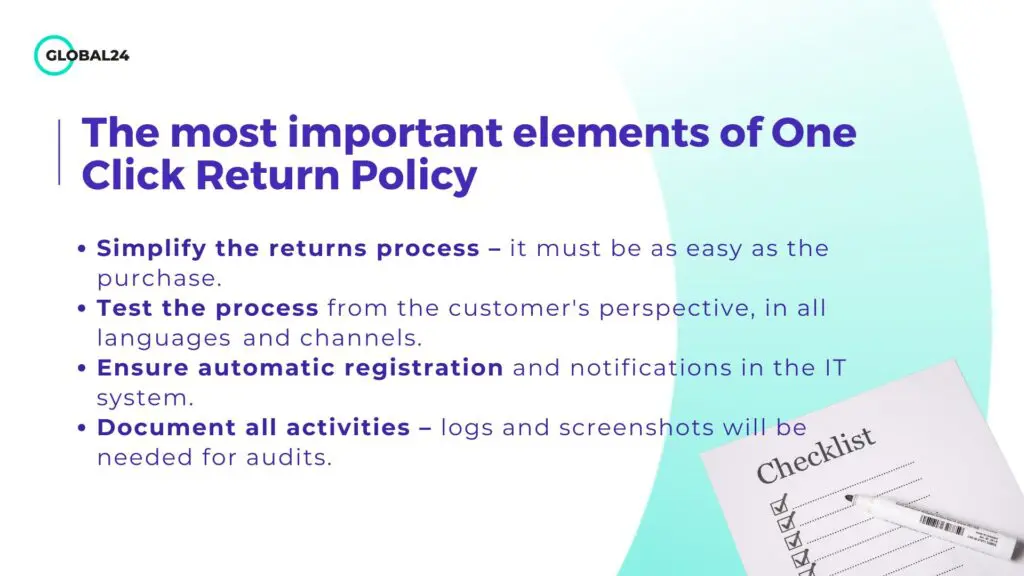
The issue of international sales is also relevant for returns logistics. Different return addresses, delivery times or billing methods can affect customer experience and process compliance. This is why implementing One Click Return in a cross-border model almost always requires looking beyond the UX of the shop.
One Click Return implementation process as an opportunity for optimisation and development
The implementation of One Click Return is an opportunity for e-commerce businesses to restructure the entire returns process – from the customer’s request through to logistics and billing.
The biggest challenge is rarely the ‘Cancel’ button itself, but what happens next: handling returns in different countries, integrating systems, ensuring the process is consistent and compliant.
This is why more and more companies are looking at the implementation of One Click Return as a reason to clean up operations and are reaching for solutions that combine the technology layer with returns logistics.
External returns handling – especially in the cross-border model – can play a key role in this process. It provides local return addresses, automatic registration of returns and integration with e-commerce systems, making it easier to meet regulatory requirements and simplify operations at the same time.
In the new reality, One Click Return can be a starting point for building a more efficient and scalable returns process – especially if you are selling across multiple markets.
Q&A - the most common questions in One Click Return implementation
Does implementing One Click Return require a large technology investment?
Not necessarily. Many popular e-commerce platforms (Shopify, Magento, Prestashop, WooCommerce) have ready-made returns features that you just need to configure and test. The bigger challenge is integrating the systems and providing a consistent customer experience across channels.
Will implementing One Click Return make customer service more difficult?
On the contrary, a well-implemented mechanism facilitates service and reduces the number of support requests. Automation and a transparent process allow the team to respond faster to emergencies only.
Do I need to change the entire returns process in my shop?
Not always. If your returns process is well designed, most of the steps may already be compliant. The hardest part is ensuring consistency across multiple languages, platforms and systems.



Do you want to be up to date?
Subscribe to the newsletter
Subscribe to the CROSS-BORDER LETTER newsletter! Learn about news, tricks and secrets in foreign logistics. Check how to sell abroad and achieve more benefits.