

One Click Return Implementation Costs for E-commerce
In this article, we will show what the costs of implementing One Click Return are, what elements may need to be changed and what factors affect the time and scale of the whole process.

Publication date:
Update date:
11.05.2026
One Click implementation costs - an introduction
From June 2026, online shops in the EU must implement the One Click Return mechanism, a simple way to withdraw from an online contract, in line with EU Directive 2023/2673.
This means providing the customer with a return process that is as simple, quick and intuitive as the purchase – with no unnecessary steps, no contact with staff and an automatic confirmation of the request.
One of the most common questions from e-commerce owners and managers is: how much will it cost to implement One Click Return?
The answer is not universal – and this is the most important starting point.
One Click Return in a nutshell: what does EU Directive 2023/2673 require of e-commerce?
One Click Return is a mechanism designed to allow the customer to cancel a contract simply, quickly and fully online, without having to contact customer service.
The legal basis for the changes is EU Directive 2023/2673, which was introduced as a response to common e-commerce practices that make it difficult for customers to withdraw from a contract – so-called dark patterns.
These include deliberately complicating the return process, hiding cancellation options, requiring support contact, or sending unclear messages that discourage the user from making a decision. As a result, returning a product or unsubscribing was often more difficult than purchasing, and the new rules aim to eliminate this.

One Click Return is therefore intended not only to simplify the process, but more importantly to equalise the standard of customer experience – so that withdrawal is as easy and accessible as concluding a contract.
This does not mean literally one click, but a process devoid of unnecessary steps and barriers, such as having to print out a return form and other similar practices. You can read more about dark patterns in our article:
How many clicks is still not One Click? – clarification for e-commerce
What does the cost of implementing One Click Return really depend on?
The cost of implementing One Click Return is a direct result of how far your current process deviates from the required standard.
This means that two shops of similar scale may have completely different implementation costs – depending on what needs to change and how extensive their infrastructure is.
The most important factors are:
- the current UX of the returns process,
- the number of systems (ERP, CRM, OMS),
- number of e-commerce platforms,
- number of markets and language versions,
- level of process automation,
- the way returns are handled (manual vs. system-based).
In summary, the more exceptions, manual handling and inconsistencies between marketplaces, the higher the cost of implementation.
It is, of course, possible that no changes to your e-commerce will be needed, but it is still worth conducting an audit and following the order and return process closely.
What elements most often need to be changed?
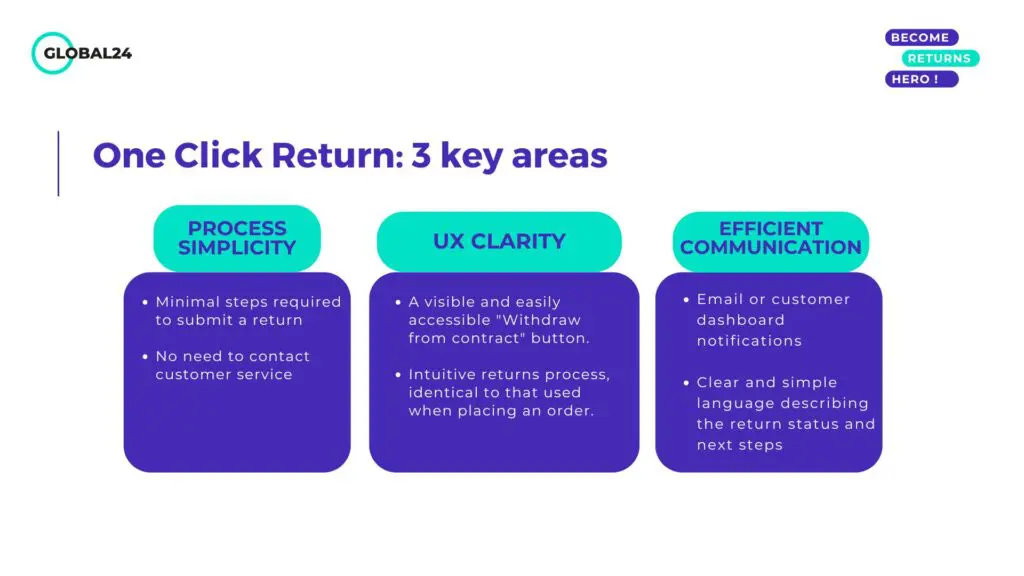
The most important guideline for the implementation of One Click Return is to simplify the return process and make it equal to the order process. Every step, every decision in the withdrawal process should be as intuitive and quick as selecting the product and finalising the purchase.
Additionally, it is a good idea to ensure that all key logs related to orders and returns are recorded and stored for possible audit purposes.
Based on this, it is easier to identify the elements that most often need to be changed in e-commerce. These are the points where the current process can create unnecessary barriers for the customer – from the user interface, to returns forms, to notifications and integration with CRM/ERP systems.
Below are key areas of e-commerce and examples of elements that may require change.
1. UX and customer interface
- easy access to order history / product return options
- visibility of the “Return/Withdrawal from the contract” button
- simplification of the return form
- elimination of additional steps (e.g. contacting customer service)
Practical instruction: Audit the return process, comparing it step-by-step with the order process. Use both your own tests and tests with users or external testers to catch non-intuitive elements.
2 System integration and process automation
- recording of requests in CRM/ERP
- synchronisation of return statuses
- automatic generation of status updates
Practice guideline: Check that all forms only require the necessary data and that the customer receives automatic confirmations of requests.
Example implementation scenario - how long does it take?
Below is a simplified example for a medium-sized e-commerce business operating in 3 countries:
| Area | Scope of change | Estimated time |
| UX audit | Returns process analysis | 1-2 days |
| UX/UI | Interface and form improvement | 2-4 days |
| Integrations | CRM/ERP + logs | 3-6 days |
| Automation | Notifications and emails | 1-3 days |
| Testing | User and cross-border scenarios | 2-3 days |
If you want to prepare for the implementation of One Click Return, take a look at our detailed article “How to implement One Click in 14 days – the operational process“. In it, we describe the key variables and help you create your own implementation plan for your new returns process.
What influences the final cost the most?
The biggest influence on the cost of implementation is the scale of your e-commerce operation and level of complexity, as well as how far your current process deviates from the required standard.
🔹 1. Number of markets and languages
Each marketplace is a separate version of your shop – often with different translations, rules and processes. If you don’t have a consistent and quick process for implementing changes on all versions at the same time, this stage can be quite time-consuming.
Because the directive covers the entire European Union, you need to carry out the changes in each language version of your shop and keep the messaging and UX consistent.
👉 What can make implementation difficult?
- lack of central content management,
- different teams responsible for different markets,
- inconsistent versions of the process between countries.
🔹 2. Number of e-commerce platforms
If a shop runs on several systems or combines own sales with marketplaces, the implementation has to be duplicated and tested in different environments, which increases the implementation time. Although in the case of marketplace platforms, the UX element in most cases will be dealt by the provider, you still should ensure it works according to the requirements.
🔹 3. Degree of automation
Where processes are still handled manually, they may need to be moved into systems – which means additional integration work and changing the way the team works.
🔹 4. System integrations
Complexity also increases with the number of systems involved in the process (ERP, CRM, OMS). Each of them needs to receive and process returns data correctly, which may require integration modifications.
The final cost, therefore, depends on 4 factors: UX + systems + logistics + scale of operations.
What if you do not implement One Click Return?
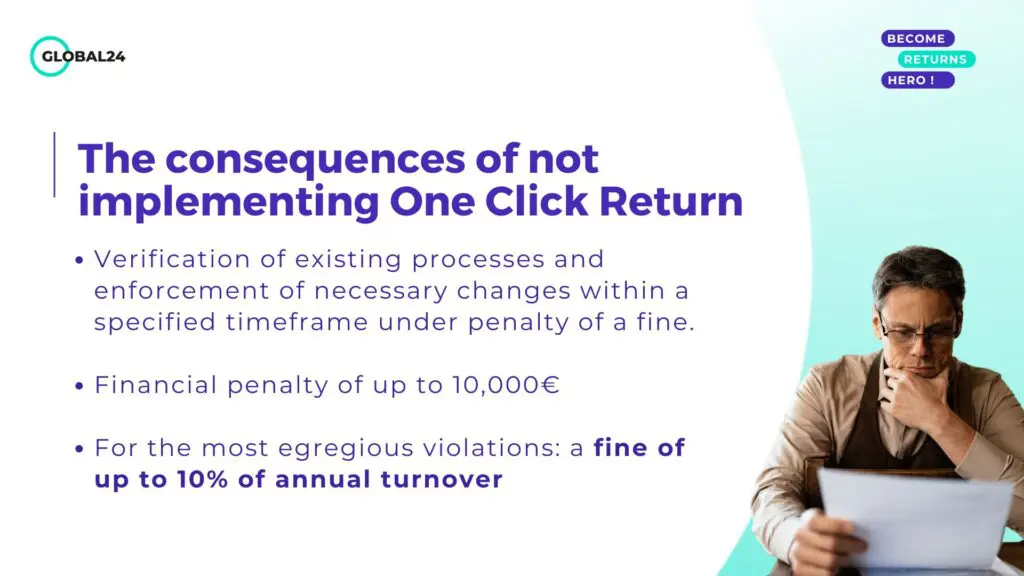
Failure to implement One Click Return before June 2026 could result in severe consequences. If your withdrawal process does not meet the requirements of the directive, you could expose your business to:
- Financial penalties: Supervisory authorities in individual EU countries can impose fines of up to several percent of a company’s annual turnover. The level of sanctions depends on the scale of the infringement and local regulations – the directive only sets a minimum level of penalties, and member states can introduce stricter rules.
- Checks and audits: The e-commerce must be able to demonstrate that the return process works in accordance with the regulations. This includes, but is not limited to, keeping system logs, claim history and documentation of the process.
- Consumer claims: If the return process is hindered, customers can pursue their rights individually through civil means.
- Operational risks: The lack of a structured process results in more errors, overloaded customer service and logistical chaos, which in practice generates additional costs and affects the operational fluidity of the shop.
It is worth noting that the EU directive only sets out a minimum framework of rules and penalties, and member states can apply stricter rules locally. Therefore, e-commerce companies operating cross-border must take into account the regulations in each market. You can read more about potential sanctions in the article “Sanctions for Lack of One Click Return: Real Risk for E-commerce”.
Implementation as an investment, not a cost
One Click Return does not have to be seen as just another expense enforced by EU regulation. It can be an opportunity to simplify and standardise the returns process with tangible operational benefits.
A correctly designed process minimises manual handling, reduces errors and allows the customer service team to focus on sales and user support instead of time-consuming administration.
At the same time, a clear and quick return mechanism improves the customer experience, increases customer satisfaction and can ultimately have a positive impact on sales and retention.
The integrations and improvements to UX or logistics procedures carried out during the implementation are nothing more than long-term support for processes across e-commerce.
In the context of cross-border sales, it is also worth looking at One Click Return as an element of scalability, especially when combined with the implementation of local returns across Europe.
The natural direction: professional handling of returns
As e-commerce grows in scale, returns cease to be just a function of the shop and start to be a separate operational process.
Therefore, more and more companies are opting for solutions that:
- provide local returns addresses in multiple countries,
- automatically register returns,
- integrate with e-commerce platforms and ERP/CRM systems,
- provide full documentation of processes.
This makes the implementation of One Click Return not only simpler, but also scalable – especially in a cross-border model.
Q&A - Frequently asked questions
Is One Click implementation always costly?
No – in many cases, an audit and minor UX tweaks and systems configuration are sufficient.
How do I estimate the implementation costs for my shop?
The costs depend on the current level of automation, the number of platforms and language versions, internal procedures and the complexity of the integration. It is best to start with an audit of the return and order processes to identify which elements need to be changed and what resources will be needed.
How much time is needed for implementation?
From a few days to a few weeks – depending on scale. Ultimately, it depends on the current automation of processes, the number of platforms, language versions, integration with ERP/CRM systems and the complexity of the UX.
Does the process actually have to fit in one click?
“One Click” does not literally mean one click. What matters is to make the process as simple and intuitive as possible. Each step should be necessary and logical, such as the selection of products to be returned and the confirmation of the request. Even 2-3 steps comply with the directive if they maintain the same level of simplicity in the purchase process.


Do you want to be up to date?
Subscribe to the newsletter
Subscribe to the CROSS-BORDER LETTER newsletter! Learn about news, tricks and secrets in foreign logistics. Check how to sell abroad and achieve more benefits.