

One Click Returns 2026: What is required for e-commerce?
One Click Return is a new standard that is due to take effect from 19 June 2026 in the EU. Find out what an online shop must implement and how to prepare domestic and international returns.

Publication date:
Update date:
11.05.2026
One Click 2026 return: highlights
According to EU Directive 2023/2673, from 19 June 2026, e-commerce businesses in the European Union will have to provide customers with a simple online withdrawal mechanism, the so-called One Click Return. The rules apply to all businesses operating in the EU, both domestic and international sales.
If you run an online shop in the EU, familiarise yourself with the requirements now, as the extent of the necessary changes and their complexity will depend on your situation and the platform you use.
One Click Return implementation may require changes to the shop interface, sales systems, and returns handling processes. Non-compliance may be considered a violation of consumer rights and lead to sanctions.
In this article, we show you:
- What exactly must an online shop implement?
- What elements are mandatory?
- How to prepare the returns process to meet the requirements of the new regulations?
Why do shops need to implement One Click Return?
The new obligations stem from EU Directive 2023/2673, which aims to reduce practices that make it difficult to opt out of digital purchases or services. The directive covers all businesses operating in the EU in foreign and domestic sales.
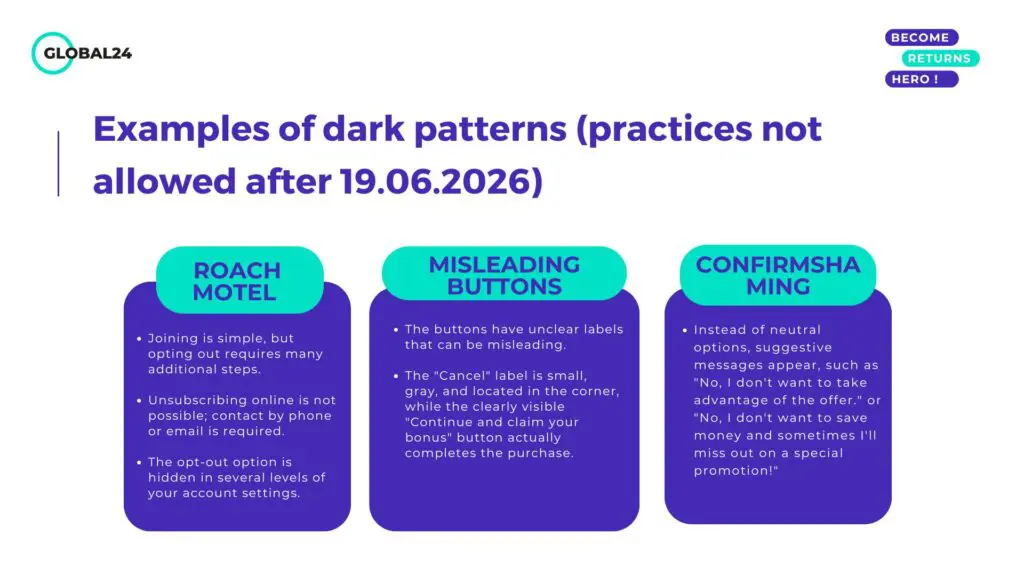
The changes are a response to so-called dark patterns, i.e. various practices that can lead customers to act against them.
These include false timers suggesting a limited offer, hidden buttons, and mechanisms based on ‘confirmshaming’, i.e. triggering negative emotions after a purchase is cancelled.
The new rules aim to change this situation completely. It is intended that cancelling a purchase should be as simple as making it.
How will One Click Return affect e-commerce processes?
Implementing a one-click return mechanism is not just a change to the shop interface. The directive clearly sets out the conditions that an online shop must meet in order to be compliant.
The most common changes include:
- user interface (UX) – the customer must be able to find the option to withdraw easily
- sales and CRM system – return request should be automatically registered
- order processing – the return process must be initiated without the involvement of a consultant
- return logistics – information about the withdrawal should be automatically sent to operational systems
This may mean that you need to introduce new integrations between systems, develop new procedures and carry out staff training.
Correct implementation of the procedure will be crucial for any e-commerce business with both foreign and domestic sales.
How should the One Click Return mechanism work?
The One Click Return mechanism means allowing the customer to easily submit a declaration of withdrawal online, usually in the customer panel or order history.
The process should look as follows:
- The customer goes to the order history.
- Selects the order or product to which the return relates.
- Confirms the decision to withdraw from the contract.
- The system automatically confirms the request.
It is important that the interface is unambiguous and does not contain elements that may mislead the user. It must be as simple as placing an order.

One Click Return versus foreign returns - what is changing in practice?
In the case of cross-border sales, the implementation of One Click Return means that the returns process needs to be standardised across all markets in which the shop operates. The customer – regardless of the country – must have access to the same simple and intuitive withdrawal mechanism.
This means that shops selling cross-border must take care not only of the interface, but also the logistics of returns – including local return addresses, support for different languages and integration of operating systems between countries.
Lack of consistency in this area can lead to non-compliance with the requirements of the directive, even if the process works well in the domestic market.
How to implement One Click Return? (checklist)
The implementation of One Click Return comes down to two areas.
Firstly, we make sure that any element of the webshop cannot be interpreted as a dark pattern.
Secondly, we align the return procedure with the standards set and ensure that it is as transparent as placing an order.
Keep in mind, however, that the changes apply to the entire European Union, so if you have several shop variants for different countries or run cross-border sales, you will need to carry out the changes on each shop and platform.
Here are the most important steps:
- User interface audit (UI/UX)
- Verify that the ‘cancel here’ button is visible on all devices (desktop, tablet, mobile).
- Verify the unambiguity of the message – do not use the words “cancel” or “cancel order” out of context.
- Make sure the user can cancel a single order item or the entire basket.
- Test the process in 3-5 steps so that it is not too complicated (Article 16e(1c)).
- Adaptation of IT systems
- Ensure integration with CRM, ERP and warehouse system so that the return is automatically recorded.
- Implement automatic generation of a confirmation on a durable medium (email or PDF) with the date and time of the withdrawal (Article 11a(4)).
- Logging of all events in the system to prove compliance in the event of an audit (Article 16a(8)).
- Operational procedures
- Prepare standard procedures and train the customer service team on their One Click responsibilities.
- Prepare standard procedures and train the customer service team on their One Click responsibilities.
- Testing and quality control
- Test with real users – check that the button and process are intuitive.
- Check compliance with WCAG 2.1 – accessibility for people with disabilities (Article 16a(6)).
- Simulate bulk returns to make sure the system generates confirmations for multiple products at the same time.
- Customer communication procedures
- Ensure that the customer receives all necessary information (contact details, return procedures, terms and conditions).
- Keep in mind the possibility to withdraw in case of last-minute information (Article 16a(5)).
- Keep information in the same language in which the customer concluded the contract and the possibility to contact a human being (Article 16d(3)).
- Monitoring and reporting
- Monthly reports: number of returns, processing time, error reports.
- Preparation of documentation for supervisory authorities in case of inspections (Article 16a(8)).
Consequences for e-commerce: what you risk if you do not implement One Click Return
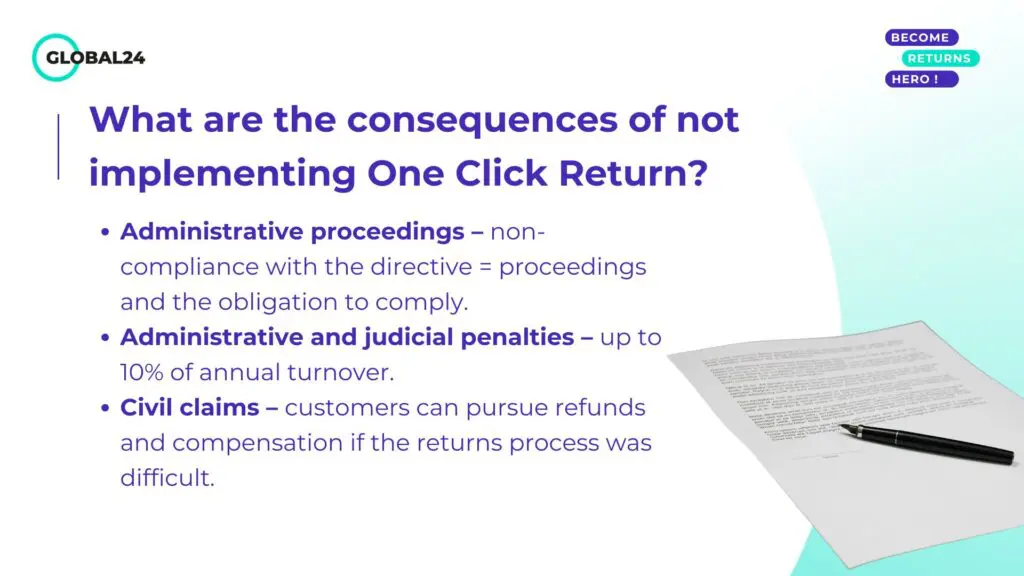
Failure to implement a simple One Click Return mechanism after 19 June 2026 will be understood as a breach of legal obligations to consumers.
The mildest consequence could be the initiation of proceedings and the imposition of an obligation to adapt sales and returns processes within a certain timeframe.
Financial penalties – fines and sanctions
In more blatant cases, the authorities can impose sanctions of even 40,000 € and, in more serious violations, up to 10% of the company’s annual turnover.
Claims from customers
If a customer has not been able to effectively exercise its right of withdrawal due to an unavailable One Click solution, it can pursue its rights through civil action, including reimbursement or compensation.
Loss of trust and reputation
Failure to bring e-commerce up to standard can lead to a decline in a shop’s reputation and thus in conversions. At the same time, the number of complaints may increase, which are often more expensive in the long term than the implementation of One Click Return alone.
What effect will the implementation of One Click Return have?
Although the new rules are mandatory, the implementation of a reimbursement mechanism can also bring real operational benefits.
A simplified returns process allows:
- process customer requests faster,
- reduce the number of queries to the customer service department,
- streamline logistics processes related to returns,
- increase the transparency of online shopping.
For online shops operating in multiple European markets, this also means that the returns process can be standardised.
Optimisation of the returns process as a response to change
The One Click Return mechanism will become a mandatory element of European e-commerce in June 2026. By then, e-commerce businesses are required to adapt their processes to comply with the guidelines.
Implementation can be time-consuming, especially if the in-store returns process is linked to several systems. Therefore, it is already worthwhile to carry out an audit and create a roadmap leading up to the new procedures.
A solution that could be the ideal foundation for implementing the new standards could be a professional returns service in Europe.
If your e-commerce business is based in the EU or the UK, our service is ideally suited to both your needs and the requirements of the new directive, providing:
- A local address for returns in EU and UK countries (compliant with SLA requirements e.g. Amazon, Otto, Zalando or BOL).
- Full record of returns handling and necessary email notifications with tracking.
- Option to verify the quality of returns.
- Support from an experienced e-commerce international returns team.
Q&A
Does every online shop operating in the EU have to implement the One Click Return mechanism?
Yes. The new legislation covers all companies selling goods or services online in the EU market, both domestically and for cross-border sales.
Does One Click Return literally mean one click?
Not always. The term refers primarily to the simplicity of the process – the customer should be able to submit a withdrawal in a quick and intuitive way.
Do the new rules also cover digital services?
Yes. The directive also applies to digital services, streaming platforms and subscriptions.
Does the implementation of One Click Return require changes to the logistics of returns?
In many cases, yes. The automatic notification of withdrawal should be linked to the order processing system and the logistics process.
If I sell outside the EU e.g. in the UK, does this law apply to me?
For the time being no. But remember that in all EU countries this law will apply to you.



Do you want to be up to date?
Subscribe to the newsletter
Subscribe to the CROSS-BORDER LETTER newsletter! Learn about news, tricks and secrets in foreign logistics. Check how to sell abroad and achieve more benefits.