

The end of cheap, duty-free parcels from China: EU and UK removes customs exception for parcels under €150
The EU and the UK are ending cheap, duty-free parcels from China and other non-EU countries. Both the EU and the UK have decided to remove the customs exception for low-value parcels (up to €150 in the EU and up to £135 in the UK).

Publication date:
Every e-commerce package will be subject to customs duties, VAT and full customs clearance. The new rules in the EU will be introduced from 1 July 2026. Although there is talk of an averaged rate of around €3 or a system of so-called buckets (5 duty rates), the reform is to be charged on a product-by-product basis.
The change is a response to the popularity of portals such as Temu, Shein and AliExpress, which today mass-market to consumers, often bypassing fair competition rules.
Initial changes will be introduced as early as 2026, with full implementation of customs reform expected by 2028. In the UK, the process is in the consultation phase, with the final abolition of the customs exemption expected by March 2029 at the latest.
For e-commerce businesses importing products from Asia, this change is an earthquake.
From this article you will learn:
- how the new EU and UK customs rules will affect your fulfilment costs,
- how this will affect your business, depending on your model: dropshipping, cross-border, local fulfilment,
- on what timescales the changes will be implemented,
- what changes in checkout, pricing and customer communication will be necessary,
- how to prepare your shop and logistics to avoid delays, penalties and a drop in conversions,
- how has it worked so far and how will it be after the changes? (example of parcels from China).
The end of cheap parcels from China
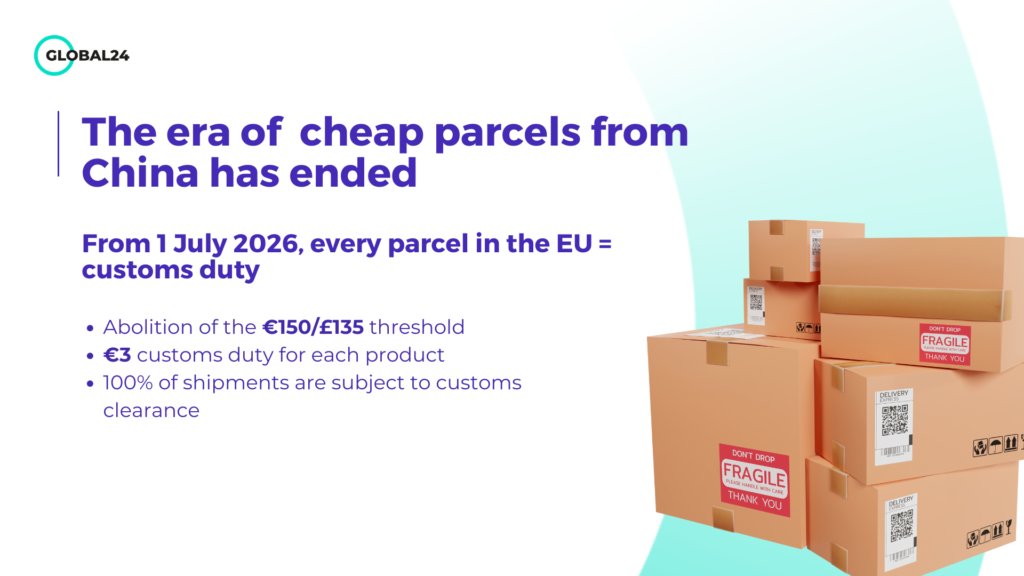
- From 1.07.2026 every parcel in the EU = customs duty.
- Abolition of the €150 / £135 threshold.
- Simplified customs rates (bucket system) or per-product charge.
- 100% of shipments subject to full digital clearance.
To understand the scale of the changes, let’s look at a simple example: an e-commerce shipment from China to the EU worth €100.
📦 Before the reform
- value of the consignment: €100
- no customs duty (below threshold of 150 € in EU / 135 £ in UK)
- VAT charged but often settled by simplified procedures (IOSS / VAT collected at checkout)
- simplified customs declaration
- low customs handling costs
- Fast clearance, few controls
Effect for e-commerce: These conditions were ideal for the dropshipping and direct-to-consumer model from Asia. Now such forms of business will require a complete restructuring.
Returns after 2026 will be more expensive:
- Every return = customs formalities.
- VAT and duty risk on reimports.
- +some days to the return process.
📦 After reform (EU: from 2026, UK: until 2029).
- consignment value: €100
- Compulsory duty – rate depending on product category (so-called buckets) or fixed charge,
- VAT still compulsory,
- full customs declaration for each parcel,
- additional handling charges (in the EU, Data Hub implementation planned),
- more controls and potential delays,
- need for precise customs data (HS codes, origin, value).
Effect for e-commerce: Higher cost of order fulfilment, higher risk of delays and need to change logistics, pricing or fulfilment strategy.
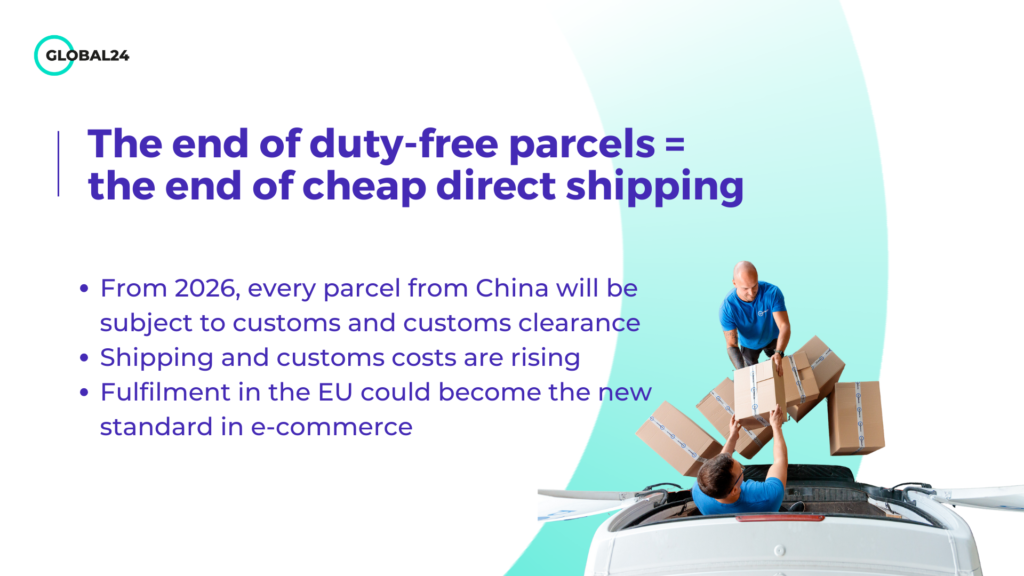
End of duty-free parcels = end of cheap direct shipping
- From 2026 onwards, every parcel from China is subject to customs duties and clearance.
- Shipping and customs costs are rising.
- Fulfillment in the EU (or fast land logistics to the Europe with Global24) could become the new standard in e-commerce.
If your business is based on products made in the EU or you sell to the UK market using trusted land routes, this could be an opportunity to find new audiences for whom buying from ‘Chinese markets’ will no longer be viable.
When do the changes come into effect in the EU?
At this point, the full scope and details of the changes being introduced are not yet known. However, we do know the planned dates for the introduction of key provisions:
- 1.07.2026 – a duty will be introduced on any product under €150. The simplified tariff system is intended to be a transitional solution.
- 2026-2028 – a transition period during which companies will be able to implement themselves into existing systems (e.g. EU Customs Data Hub) and adapt their business to the new conditions.
- 2028 – full implementation of the new law to go hand in hand with the new advanced digital customs system.
When do the changes come into effect in the UK?
The UK government has decided that relief of up to £135 will continue until at least the end of 2026.
The complete abolition of the relief and synchronisation with the new control systems is scheduled for 2029.
See how to manage returns from Europe to United Kingdom: Shopreturns – Hassle Free Returns!
What do these changes mean for companies? Summary of consequences
The removal of the duty-free threshold is not just a technical change in the rules – it is an overhaul of competition rules in European e-commerce. It is designed to support businesses producing and selling goods within the EU or the UK.
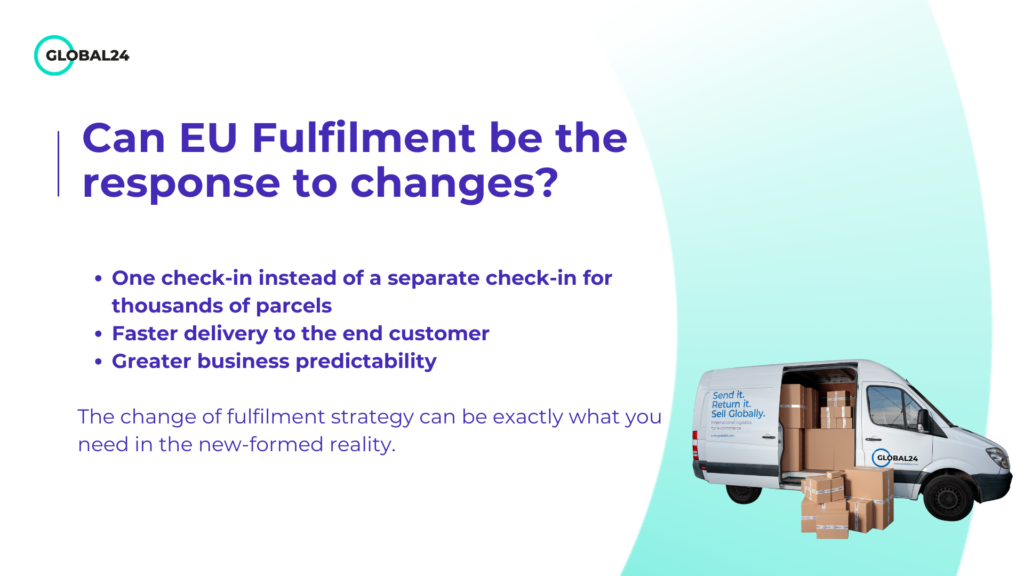
Fulfillment in the EU as a response to change?
- One bulk clearance instead of separate clearance of thousands of B2C parcels.
- Faster delivery to the end customer (e.g. Global24’s land advantage to the UK).
- Greater business predictability.
If you import products from China (and other countries outside the EU)
- You lose your price advantage based on low value parcels. The model based on cheap direct shipping from Asia no longer works optimally.
- You lose margin and have to change your pricing policy. Customs + administrative fees will make it no longer profitable to sell many products.
- Greater importance of data and customs compliance. Errors in HS codes will result in delays and penalties. Imports without automation will become a bottleneck.
- Local warehousing may prove to be the solution. More and more companies will need to consider fulfilment in the EU or UK (using fast road transport) to consolidate clearance.
For companies producing and selling in the EU
- Regain competitiveness. Reduce the price advantage of non-EU sellers.
- You have the chance to win back quality and time-sensitive deliverycustomers. Locality becomes a real advantage again.
One thing is certain: change is inevitable. The winners will be those who prepare ahead of time, sort out customs data and rethink logistics.
How to prepare for change? (checklist for e-commerce)
Here’s what you can do right now:
1. recalculate the profitability of your products after the new rules
- check which SKUs are no longer profitable after duty has been added,
- consider bundling products to optimise clearance costs,
- prepare new pricing scenarios for EU and UK markets.
2. organise your customs data – this will be critical
- verify the HS codes for the entire product range,
- make sure values and origin of goods are declared correctly,
- prepare for digital data exchange with customs systems.
Remember, it may not be possible to grow without automation and the support of an operator such as Global24, which handles cross-border e-commerce (especially in the tough post-Brexit UK).
3. rethink your logistics model change
- Consider EU or UK fulfilment,
- compare the cost of import consolidation with bulk clearance,
- bet on a fast land route that guarantees punctuality.
4 Prepare checkout and communication with the customer
- clearly communicate whether the price includes duty and VAT (DDP model),
- update regulations and FAQs.
Act earlier than your competitors. The transition period 2026-2028 is the time to optimise. Companies that find their feet quickly in the new realities will avoid operational chaos and gain an advantage when the market is still adjusting.


Do you want to be up to date?
Subscribe to the newsletter
Subscribe to the CROSS-BORDER LETTER newsletter! Learn about news, tricks and secrets in foreign logistics. Check how to sell abroad and achieve more benefits.